+

Get 7 days free to try our all-in-one platform
See how TravelJoy can help you save time, stay organized, and look professional.
Get started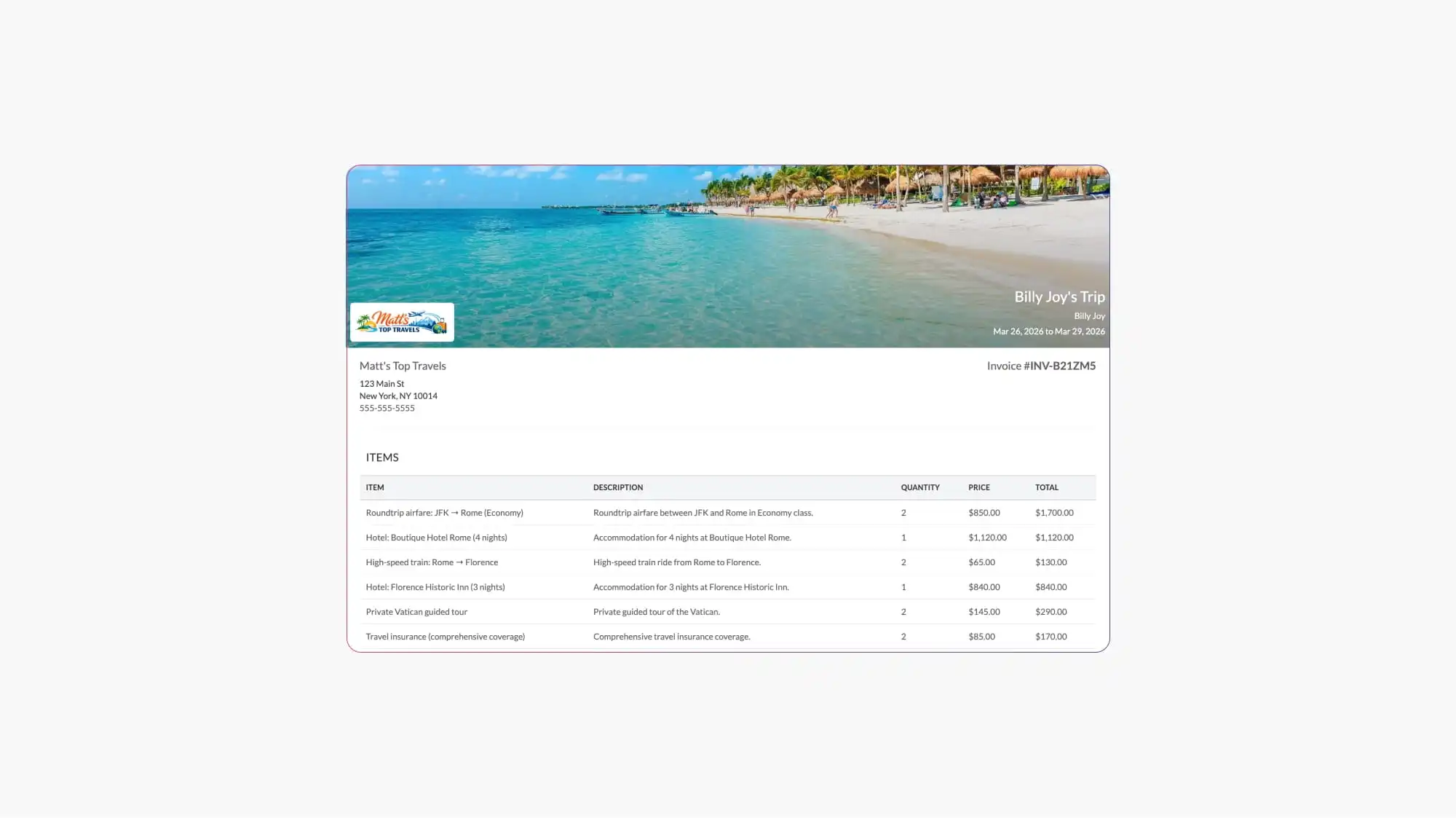

Payments are one of the most important parts of running a travel business, and often one of the most confusing. Between invoicing clients, collecting deposits, paying suppliers, and making sure your own earnings end up in your bank account, there's a lot of moving pieces. Most advisors are managing this across a mix of spreadsheets, payment links, and manual follow-ups.
TravelJoy was built to handle all of it in one place, and that's exactly what we walked through in our first-ever Payments Workshop. Whether you joined us live or plan to watch the replay, this recap is an overview of everything we covered, step by step.
A good travel agent payment system doesn't just process credit cards. It handles the full lifecycle of a payment: from the moment a client receives an invoice to the moment you pay your supplier and withdraw your earnings.
That means having branded invoices your clients can actually trust, secure authorization forms that meet PCI compliance standards, automated payment reminders that run without you having to follow up manually, and flexible options for paying suppliers once the money is collected.
It also means having everything organized in one place so you're not piecing together the payment status of a trip from five different tabs. That's the foundation TravelJoy's payment tools are built on, and it's what makes payment processing for the travel industry feel manageable rather than chaotic.
In the workshop, the first big concept we covered was the difference between direct invoices and supplier invoices.
Use a direct invoice when you are charging your client directly.
When a client pays a direct invoice:
This is where TravelJoy functions as a true travel agent payment system, allowing you to collect deposits, structure payment schedules, and automate reminders without chasing clients manually. It also allows you to collect your planning or consultation fees in a streamlined way.
Supplier invoices are used when you are collecting a client’s credit card details for a supplier charge.
In this case:
TravelJoy is fully PCI compliant, and card details are never stored on TravelJoy’s servers. That’s critical when thinking about compliance and secure payment processing for the travel industry.
If you need a simple rule of thumb:
Direct invoices charge the card directly.
Supplier invoices securely store authorization details.
Once that clicks, everything else becomes much easier.
One of the most powerful features demonstrated in the workshop was Magic Importer for invoices.
Instead of manually copying details from a supplier PDF invoice into a TravelJoy invoice, you can:
Package details, totals, payment schedules, dates, confirmation numbers are all pulled in within seconds.
For advisors handling high booking volume, this dramatically reduces admin time and minimizes manual errors.
It’s one of the most practical examples of how modern travel industry payment solutions should work: automated where possible, flexible where needed.
We also walked through automatic payment schedules.
Instead of calculating installments manually, TravelJoy can:
That eliminates one of the most common pain points in payment processing for the travel industry: chasing deposits and final payments.
One of the most common questions we hear is: How should travel agents collect planning fees? TravelJoy makes it easy to do securely and in a way that looks professional to your clients.
You can create a planning fee invoice by clicking the blue Create button and selecting Invoice (Planning Fee), or by creating a standard Direct Invoice and checking the box labeled “This is my planning fee.”
Here’s the key difference: when a planning fee invoice is paid, those funds go directly to your connected bank account automatically. They do not sit in the trip’s Funds balance waiting to be withdrawn.
That means:
While it may be tempting to collect planning fees via Zelle or Venmo, those tools don’t provide branded invoices, integrated record-keeping, or structured payment processing for the travel industry. Using a dedicated travel agent payment system reinforces that your time and expertise are professional services, and should be handled that way.
Payments don't have to feel intimidating. Once you see how the full lifecycle connects, from invoices and authorizations through to supplier payments and withdrawals, it starts to make a lot of sense.
If you're looking for step-by-step guides on anything covered here, bookmark the TravelJoy Payments Help Center. It covers the majority of topics from this workshop and is a great place to start if you want to dig deeper.


.jpg)
.jpg)
.png)
-min.webp)
.webp)
.png)
.png)
.png)
.webp)